Sunday, February 12, 2023

Small Wineries, Huge Vision, Big Flavors--Garagiste Fest '23

Malvasia Bianca makes up less than 0.2% of white grapes in California. But at Saturday's 9th Annual Garagiste Wine Festival--Southern Exposure, held at the Veterans Hall in Solvang, you could taste two wines made from this semi-obscure grape about ten feet apart. Being tiny does that for you as a winery--you can mess around, follow your passion, craft single expressions of grapes most often known for blending. Nobody is going to care too much, and it can't hurt your bottom line too much, as you barely have a line at all. Too often the big folks can't risk doing something that doesn't end in dollars. (Note, sometimes people experiment when the get big; in the beer world take Firestone Walker and its Barrelworks program, where all that 805 the masses wash down allows for things like Royal Street, an ale that apes a Sazerac, and it is almost Mardi Gras. Still....)

As for that Malvasia Bianca, the two versions were certainly distinct, even if both on the dry side for this white grape better known elsewhere in the world. For tercero, Larry Schaffer made a MB that's floral and perfect for the warmest days of spring. For Lepiane, Alison Thomson made a MB that sips like a fine vermouth. Such delightful and keen distinctions were a huge part of the thrill of the afternoon tasting.

So was a sense of discovery. Take the tongue-in-cheek Funky Town, a side project from the bigger and better known Ampelos. Winemaker Peter Work didn't want to grow complacent, so came up with this second, experimental label to play a bit. And what tasty play it is, including a Piquette made from the "leftovers" of Syrah and Grenache production, bright, fizzy, and a mere 7% ABV, so a perfect lunch wine. Then there's a spicy Carignane and an orange Albariño from a bit more skin contact that offers surprisingly chewy tannin for a "white" grape.


An event like Garagiste also lets you taste unusual terroir--for example, Pinot Noir from Marin County. Talk about your ocean effect--Kendric Vineyards is equidistant between Tomales Bay and the SF Bay. The result is a lighter, almost more Oregonian Pinot, with plenty of cherry but also earth and some oomph from stem inclusion. 

And then there are wines beyond the imagination, almost. At the Hermann York table one of the pourers preceded giving us a taste of their 2021 Galleano Rosso--a wine that's 100% Salvador grape--with the claim, "This doesn't really exist anymore. When you have it, it will either change your life or you'll say, 'It's not for me.'" It swirled an inky, almost ominous color in the glass. Indeed, it packs that kind of a wallop, think the zinniest of zinfandels in a bad mood. If you've ever wondered what the flavor of intensity is, here's your wine. Perfect for a grape that comes from uncertain parentage, it's rough and tumble and lovable all at once for being so much itself.

Sort of like Garagiste, still highlighting small producers (under 1900 cases a year), still supporting the Cal Poly Wine and Viticulture program (especially through silent auction at the event), still making clear bigger is far from better. And certainly not more interesting.

All apologies to all the fine wineries I didn't mention by wine in this write-up that offered lovely pours: Camins 2 Dreams, Dana V. Wines, Diablo Paso, Kimsey Vineyard, Montemar Wines, Silver Wines, and Tomi Cellars.

Wednesday, February 8, 2023

Wine Community Honors Jim Clendenen


Frank Ostini knew he wanted to offer a special lot at last November’s Santa Barbara Wine Auction in tribute to his great friend, wine legend Jim Clendenen, but he wasn’t sure what shape it might take. He knew he would host the event at his Hitching Post II restaurant — a beloved spot for his friend who had recently passed away — but beyond that, the shape was unclear.

“Then Roy Yamaguchi bought eight tickets and volunteered to cook,” Ostini told the crowd at the Clendenen tribute event held Saturday, February 4, “and I knew what I was doing.” Yamaguchi came from Hawaii to honor Clendenen, and many others came from all over the country, and of course the local wine community came out — with 100 people attending the exclusive evening. At a $1,000 a plate, that meant Ostini raised a fine sum for Direct Relief and Community Health Centers, which is only fitting as Clendenen helped forge the connection between Direct Relief and the wine community decades ago.

Care to read the rest then do so at the Independent's site.

Tuesday, January 31, 2023

A Review of "Cure: New Orleans Drinks and How to Mix ’Em"


What Marseilles is to the Mediterranean, New Orleans is to the Caribbean, a savory meeting place where countries and cultures, priests and pirates, hopeful and hucksters mix daringly and delightfully. It would be easy to call New Orleans the ultimate melting pot, but it’s probably more fitting to think of it as a cocktail shaker, given its long association with drink culture. So, who better to take us on a tipsy tour of the town than Neal Bodenheimer, founder of the James Beard Award-winning bar Cure? Heck he’s even co-chair of the Crescent City-based Tales of the Cocktail Foundation. (To produce this book he was ably assisted by longtime food and drink writer Emily Timberlake.) 

 Obviously the bulk of Cure: New Orleans Drinks and How to Mix ’Em (Abrams) is recipes, each one sounding more quaffable than the next, but one also may read the gorgeously photographed volume both as a guidebook and a history of the myriad ways the mercantile impulse charted cocktail history. For instance, in his Sours chapter Bodenheimer tells the tale of the effects of the Italian lemon trade in New Orleans—he asserts that by 1884 they were New Orleans’s third most valuable imported commodity, behind only coffee and sugar. How could a Brandy Crusta not have happened, with its horse’s neck lemon twist prominent inside the glass? And while Bodenheimer himself isn’t the biggest fan of that drink, he has to tip his cap to its more pleasing offspring, including the margarita and sidecar.

Want to read the rest then do so at the California Review of Books.

Sunday, January 22, 2023

The Mousse That Baaa-ed: Black Sheep Is Back

Since closing down on September 4 at its longtime Ortega Street location, the Black Sheep has been reborn on Cota Street a mere three months later. In addition to the location change, it's now officially The Black Sheep, SB Brasserie, which is fitting as the new location was for two decades the home of one of Santa Barbara's legendary restaurants, Mousse Odile. Co-owner, GM, maitre-d Ruben Perez definitely hopes to invoke the French spirit of the spot, offering coq au vin and cassoulet and more, but with a definite Santa Barbara, contemporary twist. He found a great partner in the endeavor, chef Jake Reimer, who has done the high end executive chef for restaurant groups and the private chef gig, among others, but seems very happy to have fun with Santa Barbara produce and seafood.

We had the great fortune to be hosted for a culinary trip through permutations of the tasting menu they are already billing as "famous," which might not be conceited much as predictive. For everything we tasted rocked--vibrant flavors, thrilling freshness of both ingredients and concepts. So while I could go on and on about, say, the perfect steak frites, starting with the tender Entrecôte meat itself, and then a secret sauce that's got some anchovy in it but is otherwise vegetarian and rich and almost worth licking the plate to enjoy (luckily instead you have plenty of yummy handout fries), I won't.

I also won't talk about the reinvigorated creme brûlée, spanking the oft-tired dish back to life with a pinch of salt and what must be a fistful of Tahitian vanilla bean.

Nope, to focus, let's just talk about the three dishes that opened the meal and hit the table simultaneously. Above you see an essay in fishy contrasts, some lightly pickled sardines atop some sprouts atop some tuna you can't see, but it's confit and rich. Then there's a slice of baguette on the plate awash with a mustardy sauce. The contrasting textures and flavors kept your mouth alive to flavor's possibility.


Here's the evening's crudo--it's listed on the menu as d'jour, as it sort of has to be as it needs to be something just caught to sing. This one did a little aria, so might have crawled into the kitchen on its own. Well, if scallops crawled. Again, all the accents aren't just for show but push the dishing fascinating angles and richness without hiding the pleasing, starring salinity of the scallop.


And then, as a true Santa Barbara nod, here's uni with "dirty" rice, seaweed, and tobiko. Things get a bit soupy as you eat it, but with the rice it's kind of a wet porridge of big flavor delight. Here the accoutrements reel the urchin's assertiveness in just a tiny bit, which works with all the other vivid reminders of the sea in the bowl. It's a great example of lots of technique being brought to bear on something that seems simple. 

It's wonderful to have the Black Sheep back.

Monday, January 16, 2023

Consider a Kind of Chocolate College


You might think you'd have to be a bit cocoa-crazy to want to join a chocolate-of-the-month subscription box club, but Cococlectic could convince even a casual chocolate lover. That's its whole point--think of each shipment as a chocolate education in a box, backed up with Zoom tastings with the small batch producers themselves. (Yet another one of those positives that have come thanks to the terrible pandemic.)

What you see above are the four bars I got in a sample shipment (yep, I'm singing for my freebie), from Fresco Artisan Chocolate in Lynden, WA. Note--and this is typical of each month's shipment--we're talking bars sans any bells-and-whistles, even the delicious and striking kind you might get with, say, an Omnom Black and Burnt Barley (to pick one of my favorite artisan chocolate experiences). Nope, here you're going to learn to distinguish different geographic sources for cocoa bean, so you can pick out the the sweet fig jam notes from Ghana versus the grapefruit zip from Madagascar.

Heck, they even teach you how to eat chocolate. Turns out most of us have been doing it wrong all our lives, but then again, nobody needs to have that Snickers bar sit in their mouthful too long. Instead, what's recommended by Cococlectic is to break off small pieces, smell the aroma, and then let the bite melt on your tongue. It's a slow process, but what you find is more and more comes into focus, kind of like when you settle yourself into what you at first think is a dark room (fitting for chocolate, no?). Try to put yourself in a wine tasting mood. Each shipment comes with a handy, visual tasting flavor wheel with taste descriptors, suggesting you might find everything from a vegetative cooked green olive note to a caramel, molasses one, with a possible soupçon of earthy mushroom along the way.

The best part of fine, craft bean-to-bar chocolate is you need less of it to be satisfied. All that rich cocoa goodness floods you taste buds, sort of coats them if you really keep your teeth at bay and let the chocolate melt. You don't need gobs it in an impossible effort to be pleased that only ends with you feeling grossly stuffed.

A card in your box provides more information about each purveyor--their history, their methods, their sources. Every bar is "all vegan, non-GMO, fair-trade, ethically sourced," their press releases points out, continuing, "Cococlectic’s chocolate bars do not contain any soy, gluten, dairy or nut, but they may be produced in a facility that handles these ingredients." So it's good for you chocolate! Plus, the San Francisco-based Cococlectic, which began in 2014, is a women-owned and minority diverse-owned business. (That's co-founders Doreen Leong and Brett Wallace, below.)


Monday, January 9, 2023

A Review of "You'll Like It Here"


A fascinating smudging of the notions of the novel, Ashton Politanoff’s You’ll Like It Here (Dalkey Archives) alternates between being charming and creepy, nostalgic and prophetic, dreamy and mundane. As he explains in his introduction, Politanoff, a Redondo Beach, California native since he was 8, dove into local archives upon his mom’s death and came out with this odd duck book. Fascinated by what he found, particularly from 1911-1918, especially since the period seemed to rhyme with our current age, he built a found novel, of a sort, compiling very brief news item “chapters” that never add up to a distinct plot, but certainly build mood and themes. 

Dropped into his acknowledgements is this important explanation of how he saw this project: “While I have used historical situations and newspaper clippings as the basis of this project, names have been changed, dramatic structure has been favored over historical accuracy, and facts have been expanded, all with the aim toward fiction and my own poetic and aesthetic concerns.”

Care to read the rest then do so at the California Review of Books.

Saturday, December 31, 2022

Pairing Cab Franc Perfectly in Paso

The best laid plans of writers and procrastinators.... This post should be much more detailed than it will be, given the dinner it's about happened December 3 and it's now nearly a month later with lots of holidaying under the bridge. But I would be greatly remiss if I didn't praise the warmth, kindness, and delight of an evening spent at the home of Kunal and Neeta Mittal of LXV Wines. They graciously hosted a slew of media folks and fellow winemakers as a way to kick off Cabernet Franc Day, the bulk of which happened on December 4 at Cass Winery, and which, thank god, I already wrote about. (Plus I had notes. It's so hard to take notes while trying to be a good dinner guest, it just seems rude.)

Above is the wine line-up for the evening, so that might be a bit of the reason I don't have total recall of everything ate and drunk. Not that I was the latter, but still. I certainly recall the delicious odd duck (no, not cold duck) of a welcome wine, the LXV 2021 Blanc de Sangiovese, and yes, you read that correctly. The couple had a similar wine once in Italy so insisted on trying one of their own, made with the least amount of skin contact possible from fruit from Santa Barbara County's Whitehall Vineyard. The result is racy, playful, rich, quaffable. A conversation starter and a bottle-finisher all in one


On to the many amazing courses of food. Neeta loves working on pairings, and her hope with the menu was to connect with Cab Franc's core notes of floral aromatics (often violets), fruit (generally strawberry and raspberry), vegetal character (bell pepper), and earthiness (crushed gravel). So above, we begin with that floral note by echoing it with a raclette cheese griddled to gooeyness, piled with seared sous vide octopus and then drizzled with lemon and violet oil. I have to admit I generally am not a fan of over oiling the flavor onto a dish (all those years of crappy truffle oil ruined me), but this combo was perfection, especially when it got an extra splash of the violet oil. This paired perfectly with the LXV 2020 Reserve Cab Franc, a very California-style version of CF, hearty but balanced and redolent of all sorts of aromatics, from lavender to sage.
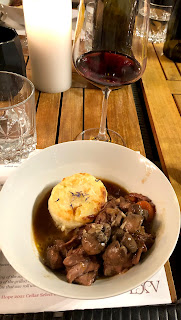

Course two was Boeuf Bourguignon with an island of scallops potatoes amidst the sauce. Starting as a standard interpretation even Julia Child would appreciate, Neeta gave it a personal twist with a hit of green cardamom (and let's face it, Bourguignon usually could use something to give it lift, as after the first few bites it can get pretty samey) plus some miso in the stock for extra umami and richness. That paired with one of my favorite wines of the weekend, Union Sacré 2020 Cabernet Franc. Go read the other post to see what I thought about it.


So, that's a lot of food with two courses to go. Luckily we next just had a little lamb, atop two street tacos. The meat, braised in herbs, was tender and earthy, the roasted vegetables adding some smoke and brightness at once. A complex dish, it deserved and received a complex wine, Austin Hope 2021 Cellar Select Cabernet Franc. A big boy (as one expects from Austin Hope) at 15% ABV, it came off as controlled power, savory and spicy.
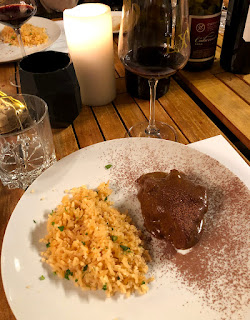

For course three we turned to Cuernavaca for a dish dear to Neeta and Kumal's hearts from a time they stayed in Puebla--chicken mole with rice. Evidently XLV has a masterful Martha in its kitchen who knows the multi-ingredient secret blend for this mole that suggested all sorts of flavors depending upon your bite, from cocoa to coffee to all spice to anise, and a semi-serious kick of chile hit, too. It successfully paired with J Lohr 2017 Cuvee St E, a take on St. Emilion featuring a blend of 63% Cabernet Franc, 30% Cabernet Sauvignon, 6% Merlot, and 1% Malbec, which no doubt is what makes the blend. Seriously, it's a serious wine with plenty of time in new French oak to give it a robustness while not masking any of the wine's nuance.

Given that wine, it wasn't too surprising that the affable Steve Peck, Director of Winegrowing at J. Lohr, also brought along a real Right Bank Bordeaux...with maybe a few more years on it than the rest of the wines we drank that evening. He even got the cork out clean. As often is the case with such a bottle, it was more an experience than deliciousness, all that cedar and graphite, but still some fruit. Peck had a story about how the bottle had been given as a gift up and down Willow Creek Road from different wine fans, and he figured it was time to share it with all. Which only goes to show the generosity of the wine community. While Cab Franc pairs well with a wide range of foods, it pairs even better with memorable hospitality.