Showing posts with label New York. Show all posts

Thursday, January 18, 2024

A Review of "Lou Reed: The King of New York" by Will Hermes


Will Hermes admits he’s on a fool’s errand with the opening quote of the preface to his 529 page biography of Lou Reed. The mercurial genius most famous as the leader of the Velvet Underground once told journalist Jonathan Cott, “There’s no reason to get into autobiographical things with me, because I’m a writer and a musician.” But Hermes, a diligent researcher (he makes clear he’s even read the archive of Reed’s sometimes terrifying “fan” mail), perceptive critic, canny social historian, and flat out elegant writer, is more than up to the task for what he himself calls “myth parsing.” As he puts it, “One gets the sense that memories might be clouded by subsequent myth, every double scotch or methamphetamine injection magnified into more smoking-gun evidence of the ‘Lou Reed’ character he blurred into by the mid-’70s.” 

 Then again, Reed went through a lot. Born in 1942 on suburban Long Island to a respectable middle class Jewish family—Hermes does wonderful work connecting Reed to that heritage—Lewis Allan Reed knew he was queer at age 12 almost two decades before Stonewall. Drawn to music and literature, New York City beckoned as it did to every artsy person in the northeast in the late 20th century. Alas Reed’s first and only year at NYU ended with him back at home and getting electroshock therapy (Hermes puts this seemingly barbaric practice into scary historic context: “In lieu of commitment to a mental hospital, an option that may have also been on the table, outpatient ECT probably seemed the lesser evil.”) Eventually Reed attends Syracuse, only to get his first case of hepatitis—and liver failure would be what led to his death in 2013—the first time he shoots heroin. It’s as if he was creating a life that could only be rock ‘n’ roll mythic.

Want to read the rest then do so at California Review of Books.

This review was also posted at the Santa Barbara Independent on February 1, 2024.

Monday, September 25, 2023

After Years of Hunting Rabbit, The Dead Rabbit


Finally going to a place you've have put the years into yearned-to-be is a fraught experience. Expectations of greatness are difficult to meet, let alone by something that hopes to be a pub. A really damn good one. Say, one that has twice been named best bar in the world at Tales of the Cocktail.

So maybe that's why instead of trying to write up my at last visit to the lauded Dead Rabbit in FiDi* New York, I instead decided to craft a cocktail from the bar's first book, The Dead Rabbit Grocery and Grog  Drinks Manual (Houghton Mifflin, 2015). Turns out that a Bijou, inspired by Harry Johnson's 1900 Bartenders' Manual, is an almost perverse delight--gin and sweet vermouth in equal parts, with some Green Chartreuse (get them monks into the glass for a good time), and soupçons of orange bitters, Angostura bitters, and Pernod. You do "garnish" by expressing orange peel over the drink, but discard the peel (pay attention, that detail will be important later).

*That's short for Financial District, and despite our desires, it's not, alas, pronounced, feh-DEE.

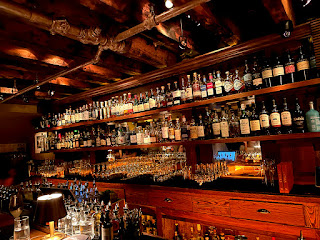
The Dead Rabbit--which takes its name from one of the Irish gangs that roamed these tip of Manhattan streets in the 19th century--earns its Irishness as its founders Sean Muldoon and Jack McGarry are two self-proclaimed "Belfast boys" who first kicked butt in their hometown, then came to New York City, because if you can make it there.... (I so didn't want to do that, but couldn't help myself.) Of all things the location is around the corner from Fraunces Tavern--you know, where Washington bid farewell to his troops--so certainly offers historical bonafides. Even if most of the current TDR building was part of the build out beyond the heavy-hewed ceiling beams, it certainly has a been-around feel in the best way. You feel as if you're entering an old lair of cocktail loveliness.

It doesn't hurt that the service is far from gruff pub land. Someone opens the door as you climb the stairs to enter. You are ushered to the host stand, and led upstairs--if you are us with a reservation--to the Parlor, billed "the cocktail cathedral" on their website. (The first floor, the Taproom, offers punch and different drinks and Irish coffee and louder craic and conviviality; the top floor, the Occasional room, is for special events.)
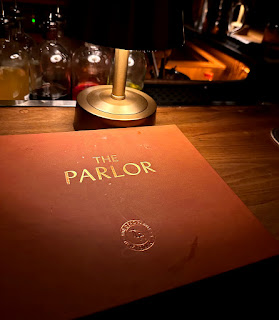
If you get sat at the bar in the Parlor, as we were, no one will be standing behind you. It's only table and bar seating, loud enough to feel buzzy, but the buzzing won't takeover your head. Plus you get to order direct from the bartender, the only one, actually, who manages to work steadily but never in a frenzy. It's a place of calm. It's like they took service tips from the French Laundry, almost, how well-timed everything is, how knowledgeable everyone is, how pleasant. 

And then there's that book above (see the entire book as PDF online). Twenty-two cocktails await (a brief panic as to how to choose and choose the best!), arranged in pairs of Tradition and Tomorrow, although Tradition is mucked with in yummy ways most of the time. The categories: Effervescent, Martini, Gimlet, Egg White, Daisy, Whiskey Sour, Savory, Tiki, Manhattan, Old Fashioned, Bitter. We scan through, and realize it might be smart for our hopefully hangover-free tomorrows to pick a core liquor and pick two of each we hope to consume over the evening. It didn't seem prudent to go from gin to scotch, say. That made whiskey an easy choice, given it grounded several of the categories.

Plus we both wanted a Buttoned Up (Chryss luckily got it), the traditional Old Fashioned. 


Each cocktail gets its own page--how seen and honored each one must feel in this temple to potent potables. TDR helpfully offers three distinguishing characteristics for each drink, a charming drawing from the Great British Bake-Off school of culinary sketches (except the finished product actually does look like its drawing at TDR), and the ingredients. Who doesn't want an opulent char, especially one that layers Angel's Envy Bourbon and Craigellachie Armagnac Cask Scotch? You know how it is--those who are buttoned-up often conceal the most power. Plus, what a perfect, clear hunk of ice. (I really need to raise my home ice game--TDR sort of shames me.)

I couldn't resist the Whiskey Sour of tomorrow, especially because I had to Google several of its ingredients (why drink what I already know?). The Amazake Kick lived up to its dried fruit, ready, robust descriptors. Amazake, which auto-correct doesn't know either, so I don't feel so bad having to look it up, is a traditional Japanese drink made from fermented rice; TDR gives even that a twist, via Ireland, of course, making theirs from soda bread. That helps led to the breadiness, of course, and the welcome homeyness is always darling in a drink. Once again there are two whiskeys--they love layering on the core pours--and then there's the odd Danish product Plum I Suppose, from Empirical, a bright botanical liqueur that brings marigold and plum. A drink like this one makes me want to be Sour a lot tomorrow.

We also ordered both versions of the Manhattan, what with our whiskey predilection for the evening and, well, that was where we were, after all. The "traditional" Jupiter Switch did what we like to do at home--use Amaro--but even gave that an unusual nudge by making it green walnut Amaro. Not that a hint of nocino is unwelcome or even that unusual in a Manhattan, but that earthy/nuttiness is a hearty touch, especially with the eucalyptus and cacao extending all the flavor's edges.


Tomorrow's Clare to Cádiz made me wonder if the present day and tomorrow are closer than they first appear. It's good to know elegance won't go out of style in the future, as this drink combines for a laser precise lusciousness, and then just enough extender notes--that hint of apple, the edge of nettle--to make it imminently quaffable. 


Most notable about all the cocktails--none were served with garnishes. The aromatics were all poured into the glass, and nothing detracted from the prefect crystal and the combined elixirs inside. And combined they always were. Cocktails at TDR--at least our four pours--all did that "let's make a whole new terrific taste" trick, as opposed to the, "I'm getting the whiskey, I'm getting vermouth, I'm getting the Angostura" bippity-bip moments of some cocktails elsewhere. 

I would also be remiss if I left out the food. I came in with little to no expectations there, assuming it would be all about the mixology. But I was sorely wrong. It's pub food, yes, but every bit as thought-through as the cocktail menu. Take these perfect deviled eggs, elevated with smoked salmon, herbed creme fraiche, caviar, espelette and dill. Savory, creamy, salty, devilishly addictive.


And we didn't photograph the rest of our food, partially as the light was dim enough (no, not too) that good photography wasn't easy, and partially because we were hungry (our evening came after a day of coast-to-coast flying and conquering the NYC transit system with two suitcases). Chryss had the fish and chips, a large enough platter we could have shared it even in our famished state--Harp Lager battered cod, mushy peas, crispy chips, and Ballymaloe tartar sauce (which made us recall our impressive lunch at Ballymaloe a few years back). Each item was nailed.

I went for the Bangers and Mash, a plate named simply so that every thirteen year old boy could suffer a giggle fit. The Cumberland sausage themselves were tasty little numbers, the pork in a good grind and well-spiced. But, of course, this dish is all about its accoutrements, especially that scallion-flecked mash potato, creamy yet not mush, and a lick-the-plate worthy gravy that brought the whole dish together.

The Dead Rabbit surpassed all expectations, and then some. It was mighty hard not to try one last tipple--I regret passing on their Irish coffee, but I don't regret not falling hard asleep that evening, too.

Tuesday, October 19, 2021

A Review of "The History of Bones" by John Lurie


John Lurie, musician, artist, reluctant actor, avatar of 1980s downtown New York City cool, makes this pronouncement fifty pages in to his fascinating memoir The History of Bones, “Also, people always talk about talent. But really, of this I am quite certain. There is no such thing as talent, there is only cleaning the mirror.” 

 How better to clean one’s mirror than to pen a revealing memoir? You don’t have to read deep in the book to decide Lurie is an uncompromising artist more than willing to be an asshole, but by the end he seems more sinned upon than sinning. 

 Want to read the rest then do so at the California Review of Books.

Wednesday, November 23, 2016

Just What the Apothecary Ordered


So yeah, it might seem frivolous to still blog on about food, wine, and drink while, perhaps, America as we love it gets coated in Fascist Cheeto Dust. But there are several good arguments against such a claim. First, you'll take my delicious delights when you pry them from my cold dead fingers. Second, all protest and no rest and relaxation makes George a crazed boy. Third, as the Titanic went down, Ben Guggenheim, after putting his mistress in a lifeboat, returned to his stateroom and re-appeared dressed in full evening wear. Rumor has it he also sent this message along with one of the few survivors: "If anything should happen to me, tell my wife in New York that I've done my best in doing my duty." (You read those two sentences correctly, promise.) He then had a cognac and a cigar.

Welcome to Apothéke. Hidden in the warren that is Manhattan's Chinatown (next to the oldest continually serving dim sum place in town, actually, and also recommended), it's in a spot that looks backlot, with its corners and buildings so perfectly out of Rear Window almost. But it's far from low rent: The Prescription List, as they call the menu, doesn't have prices, so there's that (drinks turn out to be $16-$18); if you can't afford the medicine, welcome to the world of Trump (bye bye ACA!).

The interior is speakeasy delightful with scientific touches (let's not call it steampunk so I can feel better about it)--rich wood floors, padded walls, low banquets, some brick, a dark tin ceiling, and lights made with apothecary-style bottles. The bartenders wear lab coats and you don't talk to them, even if you order from the bar; they are better than you, and their drinks will prove it. A good half the menu attests to their devotion to absinthe, which of course adds to the thrillingly cool "is this the last bar one of Jack the Ripper's victims imbibed in" vibe.

Apothéke's drinks do something that's hard to do--surprise yet still remain drinkable. Sure, someone could spin up a never-before-tasted concoction of navy strength gin, peaty scotch, a vermouth you've never heard of, egg white, and shrimp paste, but then you realize, "Hey, there's a reason I never heard of this." And your next thought is, "And where's the bathroom?"

While adventurous, Apothéke nails balance every time in drinks that sum up their parts as opposed to give you a series of waves of tastes. Take the Faerie's Tale, made of absinthe, gin, cucumber syrup, honey, lemon, egg white--nothing too unexpected, but then also--muddled green bell pepper and watercress. That green gives the drink a striking color greener than any absinthe could, but also grounds the drink, giving it a pleasing pepper core (that watercress is peppery too).

They like their farmers market, they do; take the Stolen from Eden, made with gin, snow pea, dill, basil, pink and black peppercorn, lime, and agave. I'm not sure exactly their process in juicing the veggies, or marinating them, or whatever the process, but they consistently manage to get flavor highlights that sparkle and please without ever getting any fibrousness, or even any of the off-characters a green pepper can bring to alcohol (just ask a winemaker with too much pyrazine in their cabernet).

And how could you go wrong with a Catcher in the Rye of rye, Amaro Nonino, hand-made honey and chamomile cordial, and peated scotch mist, or with a Paid Vacation of mezcal, tequila, hickory smoked pineapple, muddled cucumber, agave, habanero bitters, and fresh lime? These are drinks just familiar enough, but then even more complex than their more familiar cousins (chamomile! hickory smoked pineapple!).

They also garnish cleverly and inventively, with a pineapple frond in that Paid Vacation, a green pepper round in the Faerie's Tale, a basil leaf balancing pink peppercorns in the Stolen from Eden like a cocktail decked out early for Christmas.

And then we had to try this one, after realizing we were in the hands, and shakers, of masters--the Siren's Call of Ford's gin (that's the house gin), roasted seaweed, cucumber, squid ink, fresh ginger, with a smoked black sea salt rim, plus a mussel shell with a pearl that turned out to be rock candy. A bit murky in look but not as black as you might guess from the squid ink, it had a bracing oceanic oomph to it while still staying in balance, with the smoky notes helping--delightful firewater, you might say. Fascinating.


Friday, December 13, 2013

When Batali's in Your Eye Like a Big Food Mall, That's Eataly!

The worst thing about Eataly--beyond, of course, it's merely at best first blush clever name--is its muchness. It's sort of a Costco of Italian gustatory greatness. The best thing about Eataly--it's sort of a Costco of Italian gustatory greatness. There's no way you could eat it all, even if you were as big as Mario Batali himself, so mostly you walk through with your eyes agog and your salivary glands mimicking Niagara. For it all looks good--it's Italian food, after all. Even just the marbled swirls of perfect prosciutto is enough to make you want to pen prose poems.

In case you've never been, it goes like this--New York City, whole block, extra glam points for being across the street from the Flatiron Building. Walk in and it's a bit of a maze of a market, arranged around topics like kitchen goods or cheese or the wine store that has its own separate entrance, plus 11 restaurants/prepared food stops. For instance, you can get lattes that had some fancier name than latte that will be some of the best coffee you've ever had, very rich and, yes, European. Plus pretty.


After that, the ogle is on. More dried pasta than there are ways to misspell strozzapreti, more gorgeous Alessi-designed gadgets than guesses as to what the gadgets actually do, more imported artisanal beers that you've never seen imported before, more more more. It's impressive and at a certain point almost frightening, to live in a world so rich of things you never before knew you needed to want.

And we're not talking about a watering down of things--this isn't Disney does Italy featuring your host Pinocchio (be sure to buy your wooden dummy on the way out the gift shop). It's all fine quality stuff, often at the price too match. At least the restaurants aren't too dear, and we can vouch for the pasta at La Pizza & Pasta, as well as the good service, and that it is enough separated from the market floor you don't feel to hustled or rushed. I savored my Gnocchi al Ragu di Agnello, the gnocchi tasty and substantial but not too doughy, the lamb ragu just what you want of anything long-stewed, flavor left to sit in itself and become more if itself. (There's that more theme again.)

We also had to take the elevator ride to the rooftop Birreria, even though we had already lunched. It's probably even more pleasant when the roof's glass can be cracked open on a warm day (we were there on a chilly, if clear, November one), but it's a charming space with some good Manhattan tower views. And beer. The house brews have been dreamt up by Sam Calagione of Dogfish Head, Teo Musso of Baladin, and Leonardo Di Vincenzo of Birra Del Borgo (alas Vinnie Cilurzo of Russian River dropped out, despite having clearly an Italian enough name), and on cask they are truly unique. We had the chestnut mild ale Wanda and the thyme pale ale Gina and preferred Gina, liking the herb attack more than being nuts for the nuts. Even better, the bartender was one of those teasingly-insulting types you sort of hope you get in NYC, even if he was too young and handsome to fill out the stereotype of the crotchety old bar keep perfectly. This, I guess, is a sign of progress.


Then, just before we left, to give us one last "this might be some sort of set for a reality show of a life you aren't worthy enough to live" vibe, we walked by cheftestant Travis Masar from the current season of Top Chef. Ah, New York.