Showing posts with label cabernet franc. Show all posts

Saturday, December 31, 2022

Pairing Cab Franc Perfectly in Paso

The best laid plans of writers and procrastinators.... This post should be much more detailed than it will be, given the dinner it's about happened December 3 and it's now nearly a month later with lots of holidaying under the bridge. But I would be greatly remiss if I didn't praise the warmth, kindness, and delight of an evening spent at the home of Kunal and Neeta Mittal of LXV Wines. They graciously hosted a slew of media folks and fellow winemakers as a way to kick off Cabernet Franc Day, the bulk of which happened on December 4 at Cass Winery, and which, thank god, I already wrote about. (Plus I had notes. It's so hard to take notes while trying to be a good dinner guest, it just seems rude.)

Above is the wine line-up for the evening, so that might be a bit of the reason I don't have total recall of everything ate and drunk. Not that I was the latter, but still. I certainly recall the delicious odd duck (no, not cold duck) of a welcome wine, the LXV 2021 Blanc de Sangiovese, and yes, you read that correctly. The couple had a similar wine once in Italy so insisted on trying one of their own, made with the least amount of skin contact possible from fruit from Santa Barbara County's Whitehall Vineyard. The result is racy, playful, rich, quaffable. A conversation starter and a bottle-finisher all in one


On to the many amazing courses of food. Neeta loves working on pairings, and her hope with the menu was to connect with Cab Franc's core notes of floral aromatics (often violets), fruit (generally strawberry and raspberry), vegetal character (bell pepper), and earthiness (crushed gravel). So above, we begin with that floral note by echoing it with a raclette cheese griddled to gooeyness, piled with seared sous vide octopus and then drizzled with lemon and violet oil. I have to admit I generally am not a fan of over oiling the flavor onto a dish (all those years of crappy truffle oil ruined me), but this combo was perfection, especially when it got an extra splash of the violet oil. This paired perfectly with the LXV 2020 Reserve Cab Franc, a very California-style version of CF, hearty but balanced and redolent of all sorts of aromatics, from lavender to sage.


Course two was Boeuf Bourguignon with an island of scallops potatoes amidst the sauce. Starting as a standard interpretation even Julia Child would appreciate, Neeta gave it a personal twist with a hit of green cardamom (and let's face it, Bourguignon usually could use something to give it lift, as after the first few bites it can get pretty samey) plus some miso in the stock for extra umami and richness. That paired with one of my favorite wines of the weekend, Union Sacré 2020 Cabernet Franc. Go read the other post to see what I thought about it.


So, that's a lot of food with two courses to go. Luckily we next just had a little lamb, atop two street tacos. The meat, braised in herbs, was tender and earthy, the roasted vegetables adding some smoke and brightness at once. A complex dish, it deserved and received a complex wine, Austin Hope 2021 Cellar Select Cabernet Franc. A big boy (as one expects from Austin Hope) at 15% ABV, it came off as controlled power, savory and spicy.


For course three we turned to Cuernavaca for a dish dear to Neeta and Kumal's hearts from a time they stayed in Puebla--chicken mole with rice. Evidently XLV has a masterful Martha in its kitchen who knows the multi-ingredient secret blend for this mole that suggested all sorts of flavors depending upon your bite, from cocoa to coffee to all spice to anise, and a semi-serious kick of chile hit, too. It successfully paired with J Lohr 2017 Cuvee St E, a take on St. Emilion featuring a blend of 63% Cabernet Franc, 30% Cabernet Sauvignon, 6% Merlot, and 1% Malbec, which no doubt is what makes the blend. Seriously, it's a serious wine with plenty of time in new French oak to give it a robustness while not masking any of the wine's nuance.

Given that wine, it wasn't too surprising that the affable Steve Peck, Director of Winegrowing at J. Lohr, also brought along a real Right Bank Bordeaux...with maybe a few more years on it than the rest of the wines we drank that evening. He even got the cork out clean. As often is the case with such a bottle, it was more an experience than deliciousness, all that cedar and graphite, but still some fruit. Peck had a story about how the bottle had been given as a gift up and down Willow Creek Road from different wine fans, and he figured it was time to share it with all. Which only goes to show the generosity of the wine community. While Cab Franc pairs well with a wide range of foods, it pairs even better with memorable hospitality.

Monday, December 12, 2022

Cab Francs for the Memories


One way to think about Cabernet Franc and Cabernet Sauvignon is to compare them to Muddy Waters and The Rolling Stones. (Note--if you're a blues fan, ymmv with this analogy.) CF is the genetic daddy of CS (along with Merlot and Carmenere), but isn't as well know among the masses. You could argue CS turned up and popularized the volume on CF, in the same way that Mick and the gang (perhaps, in this case I should say Keith and the gang?) upped the ante on everything. (At least there's no race issues and appropriation concerns when it comes to the grapes.)

So it's good to know someone cares to blow Cab Franc's trumpet, which is what December 4th's Cabernet Franc Day in Paso Robles was all about. This inaugural event featured a seminar on Cab Francs around the world and then, not surprisingly, drove the CF point home with a tasting from 16 producers from Paso Robles. Lori Budd of Dracaena Wines was the instigator of this event, partially because she makes a very fine CF, but we'll get to that.

First there was the seminar, hosted by Kunal and Neeta Mittal (in the middle and right in the above photo) of LXV Wines. (Bet you can guess what one of their favorite varietals is.) To their left was the presenter of the seminar, Wes Hagen, who is as quick with a quoted quip as he is with a reasoned guess at the amount of stem inclusion in a particular pour. In many ways he was a perfect host as his storied career has centered in Santa Barbara on Pinot Noir--as a double outsider he brought refreshing, new insights to all things CF. He even had his own musical metaphor to kick off, calling CS heavy metal and CF jazz. And he also offered this wonderful "theory" of drinking: "I drink beer standing up, wine seated at the table, and spirits between the table and the floor." (He tasted with us pacing, so maybe presentational consumption created its own categories.)

We got to taste along in a global trip through six CF producing regions, kicking off with its classic representation, one from the Loire. This was the 2018 Vignerons de Saumur Rouge "Les Epinats," a lighter style of the grape, with lots of dusty tannins, pepper, and mineral notes.


Wine #2 took us to the right bank in Bordeaux for a 2018 Château Bel Air St. Emilion. This was a bit of a cheat as it's a 50/50 CF/Merlot blend, and it turns out the two bring out fine qualities in the other. Despite its practically slutty color it's an elegant pour with just a hint of brett; Hagen argued that helped age it faster in a way, an "acceptable flaw" at such a slight addition. The wine didn't suffer from any Band-Aid nose, that's for sure.

Wine #3 was my favorite of the international six and a true surprise, as I haven't imbibed much from Hungary, to be honest. But the 2017 Havas & Timár, Franom, Eger Region offered plenty of the varietal characteristic strawberry on the nose and palate, but gave a twist on the typical bell pepper notes by bringing some red bell pepper. (What else from the land of paprika?)
 
 
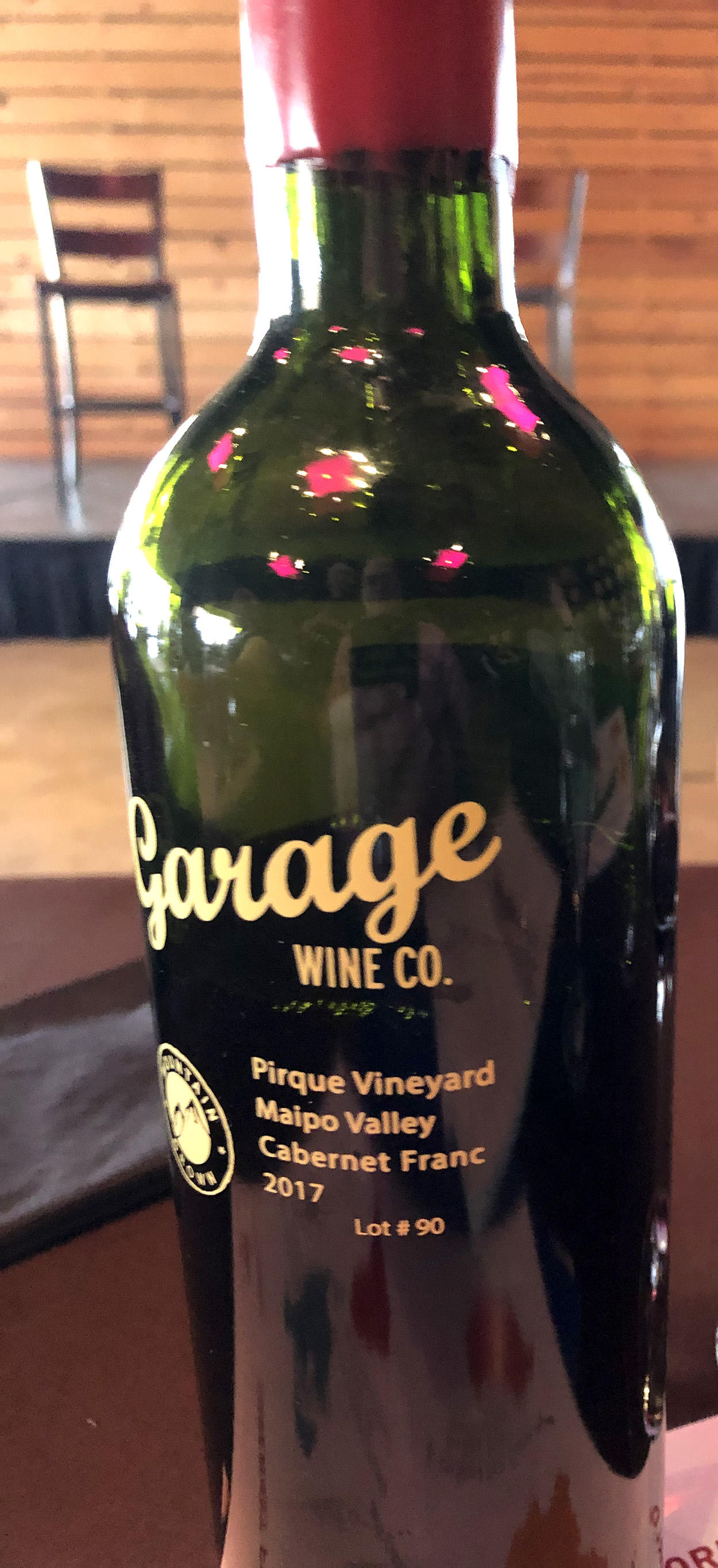
We moved to the New World with wine #4, a CF from the Garage Wine Co. (yep, the so on-the-nose version of garagiste led to numerous Hagen jokes), Pirque Vineyard, Maipo, Chile. Hagen hailed it as the most varietally typical up to that point (take that, France), discussing what calling something a round wine meant to Germans--not to describe a zaftig wine, but one that told a full, beginning, middle, end story. This Maipo had that narrative flow down, especially bringing the characteristic pyrazines. That hint of green pepper is often (not always) a signature of CF. The Maipo even had a kick of mint to it.


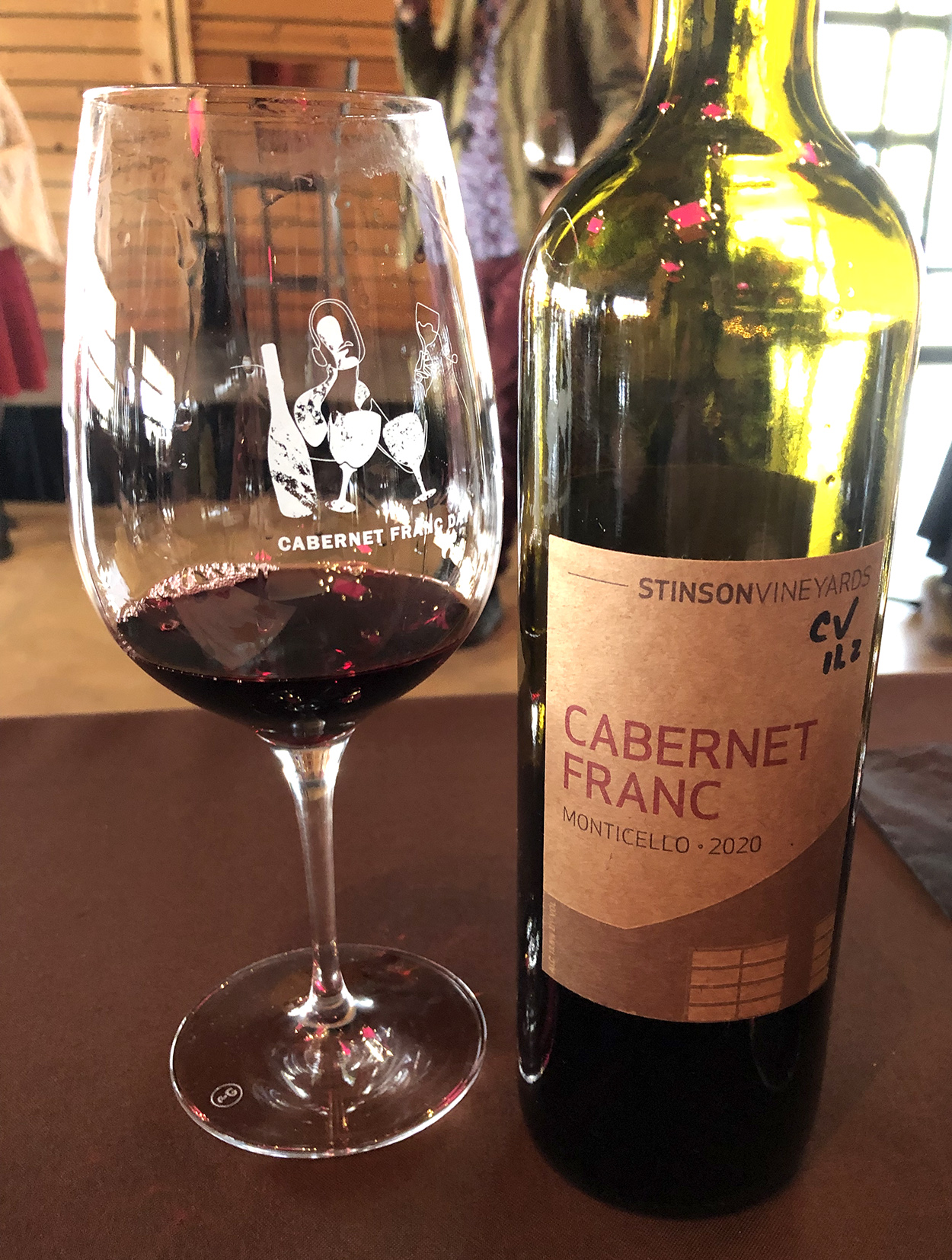
I will do my best not to be a catty Californian about wine #5, from Virginia. You have to hand it to the Stinson Family for making a quaffable CF 10 miles from Monticello, where Jefferson struck out trying to make wine from any grape centuries prior. So they've got that on one of the Founding Fathers. This 2020 had less of the usual fruit than the others, so they made up for that with other notes, like whole berry fermentation (if destemmed) and probably more oak.


We closed with Napa, and the biggest of the wines, because, as I wrote, Napa. The 2016 Crocker and Star is officially a "Red Wine of Cabernet Franc" as it's 68% CF, 23% CS, 7% Petit Verdot, and 2% Malbec. This one was a teeth-stainer, dark dark red and by far the oakiest of all the pours. Definitely for a certain taste, but it pulled that velvet hammer pummeling successfully.


All in all, a delightful trip around the globe in a series of CF glasses, such as the one Hagen contemplates above. One of his closing comments certainly left us all with something to consider; he said, "Wine is the only time machine that works...it's quantum." And getting to go to Hungary five years ago while sitting on my ass in Paso certainly proved that.

Between the global tasting and the Paso tasting there was a quick Paso panel that featured Stasi Seay, Director of Vineyards at Hope Family Wines, Michael Mooney, President/Winemaker at Chateau Margene, and Steve Peck, Director of Winegrowing at J. Lohr. Hagen, as moderator, kept it quick and the panelists kept it clever. Mooney was sure to point out that "Paso is not Paso--it has 11 sub AVAs reflecting differences from altitude, proximity to the ocean, soil composition." And to set us up for the Paso tasting, Peck admitted, "At J Lohr, about our best wine in the cellar is a Cab Franc, and about our worst wine in the cellar is a Cab Franc." So volatility can be expected.

Not that what anyone was pouring from the Grand Tasting was anything less than good--actually 8 of the 16 wines poured were already sold out (thanks for sharing, kind wineries!). Perhaps it comes down to CF being an easier grape to grow than something fussy like Pinot Noir; perhaps it's because a winemaker has to love the grape to want to make it, given consumers aren't busting down the door to buy it (heck, there's slightly more CA acreage of Petit Verdot than CF)(sure that's mostly going into blends, but still).


That said, the standout for me was Union Sacré, a small producer that generally focuses on Alsatian wines that's based in Tin City. Their website wonderfully announces: "These are not wines of privilege and power, these are wines made from a lifetime of labor for the untelevised tables that unite the very heart of the world." So, consider their CF as literate. Bright and balanced, plenty of fruit but also violets, spice, just enough earth to keep things grounded. A gorgeous effort.


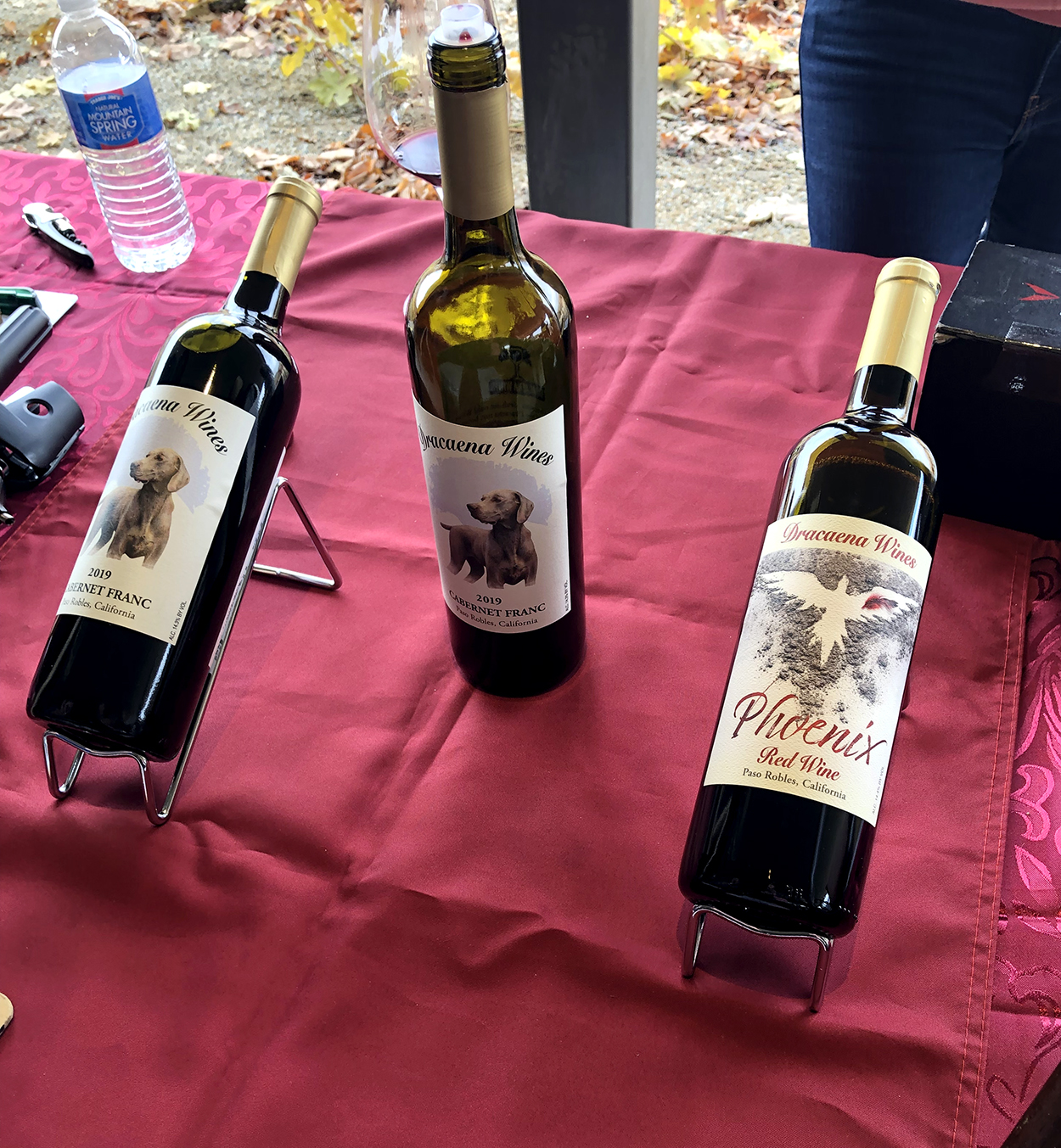
And I promised you I'd get back to Dracaena. (BTW, there's science and stars and dragons and dogs in the name--go to their website to get the full story.) Their 2019 Classic CF (they do a reserve, too, but that's long gone) gets a bit more backbone with 8% Petit Verdot, and it all comes together in wine delivering dark cherry and plum with some cocoa and a rich mouthfeel--particularly good on a bit of a blustery December day. Also notable is their NV Phoenix that blends 77% Cabernet Franc, 18% Merlot, and 5% Petit Verdot as a way to deal with the smoke taint in their vineyards after all of the fires in 2020. The wine does have a hint of smoke--but as a mezcal and Islay lover, that's kind of fun in a wine, now and again. So if you want something a bit unusual....

And I'd be remiss not to discuss the great food pairings put together by Neeta Mittal and chef Charlie Paladin of Cass Winery (where the event was held). The grazing bar offered all sorts of spreadable, from a smoky baba ghanoush to a hummus of some depth thanks to fried garbanzos, but it was the passed apps that really starred, from South Indian lentil cakes to a dusk breast seared rare with a cherry demi-glacé. Every bite proved what a versatile wine pair Cab Franc can be.

There were lots more fine wines, some of which I'll get to whenever I get to part two of the story covering a special media and friends celebration dinner the night prior. But in the meantime, here's the view for the grand tasting, wine country winter in all its ragged glory.


Sunday, September 20, 2020

Chilling with Franc, Cab Franc


It's tricky to parse the wine-making business from the wine-selling business--because, you know, there's that business part. Given many smaller producers sell much of their wine through on-site wine tasting--as opposed to hawking boxes out of box malls, say--life in the age of COVID has made that business part hard. Luckily, when the going gets hard, the hard-up come up with a clever gimmick like Francs n' Franks.

A couple of weeks ago Buttonwood Farms & Winery hosted a webinar that you got to eat and drink along with, sort of a dream Zoom (it was on FB and Yahoo live, actually). Some folks were even on site for the event, where they got treated to a BBQ of franks (sounded mostly like sausages, actually, but that ruins that fun nomenclature), a fuller tasting (four wines compared to the home two-pack), and the ability to hear the panel of winemaker Karen Steinwachs, assistant winemaker Brett Reeves, and Matt Kettmann from Wine Enthusiast and Indy fame (he's busy getting ready to publish the book about SB wines, even) live. For some reason, our connection worked best through one of our iPhones, and not through our laptop. 

You see, the generally high acid Cabernet Franc tends to work well with smoky flavors, hence the idea grilling would be good. At that point, you sort of have to make the name joke, don't you? (As if I could ever give someone the slightest bit of a hard time for pushing a bit of wordplay, c'mon.) The "home kit" featured a bottle of Buttonwood's 2017 barrel-fermented/aged Cab Franc and their more experimental 2019 Carbonique--Cab Franc that goes through carbonic maceration. The simplest way to think of this is the "regular" CF ferments in open vessels, while the carbonic CF ferments in a closed vessel. That means the grapes ferment from the inside out. And, if you're Steniwachs, whose desk at the winery is near the closed fermenter, you hope nothing explodes (at least that's what she joked).

The difference is a "lighter" wine, more fruit-forward--which is important for Buttonwood's Cab Franc as it tends to grow smaller berries. Note that vintage difference, too--you also drink it sooner. It's meant to be a "fresh" wine. Thanks to those profiles, they suggest you give it a bit of a chill, too. Yes, a red! It's ok. It certainly works with the hotdogs, even our rather soulless vegan ones (think of them as carrying devices for sweet relish and miso mayo).

Nothing was soulless about the event, though. Karen is always good for a sly aside or two, and the wine knowledge of all the participants was of course top-notch without being any kind of pedantic. So a good time was had by us, and it seemed, everyone. Even if those of us not tasting safely socially distanced on site didn't get to try the Carbonique both chilled and room temp, or try the 2007 Cab Franc. And we didn't get to celebrate Kettmann's birthday with cake, either. He owes us one.

By the way, we didn't finish the 2017 CF that afternoon, and since it was a mighty hot weekend, we kept it in the fridge until the next day. Turns out it's quite good with a bit of a chill too, if heartier and deeper than it's carbonic cousin.